Alexandr Zahatski
I am interested in personal publishing, decentralised systems and software engineering 💻

🖥 Projects
Podlite is a lightweight block-based markup language designed for flexibility and ease of use.
Project on github: github.com/podlite
Specification of Podlite: podlite.org/specification
Podlite for Desktop - open-source desktop Podlite markup language editor for Windows, Linux, and Mac.
Podlite for Web - A minimal, lightweight starter for creating static blogs/sites using nexjs and Podlite markup language
Latest record:

Most of the thoughts I have during a workday never get turned into a note. To write something down, I first have to pick a place to put it. Deciding where to save it can make me lose my focus.
So I built an app with no decision step. Right now you don't choose where a note goes. Axona 0.1.1 is a desktop app for macOS. Press ⌃⌥N in any app and type your note. Axona stores it in an inbox folder and names the file with the date. Press ⌃⌥Space to look through all your notes. Your notes are plain-text files stored on your own hard drive, written in Markdown or Podlite. The search index is temporary, and the app can rebuild it.

The app is built on habits I've used for about ten years to control my focus at work. Once I believe I can find a note again, I don't need to keep it in my head, and I can concentrate on the task at hand. For me, these habits also help me take care of my health, not just my mental health.
The idea for Axona is more than six years old. During that time, some of the libraries I used for the interface changed their licenses, but that ended up being a minor issue. The major change was that language models became a practical tool in software development, and that shifted how software is built.
This isn't about writing code more quickly; that's the dullest part. I used to evaluate an idea by how many hours it would require. I let go of good ideas, not because they were poor, but because I would never have enough time for them. Time holds me back less now. I can take on projects I would never have started before.
That's why I'll remember this release: for the first time, I put more effort into deciding what the program should do and how it should appear than into actually coding it. I have to admit it: I loved it.
I feel the difference in my body. Routine used to fill most of the day, and product decisions came at the end, when I was exhausted and had very little attention left.
A large language model agent helps me with the design. It remembers the instructions I've given it and helps me compare each new idea against my own guidelines. The agent works like a reference I can talk to.
The guidelines start from one principle: the interface should require as little unnecessary mental effort as possible to use. The broader goal is that saved notes get reused in my work and help me think.
It's still early. Some screens are blank, like the calendar, and the link graph is very simple. But I've already moved part of my own work into Axona, and I use it every day.
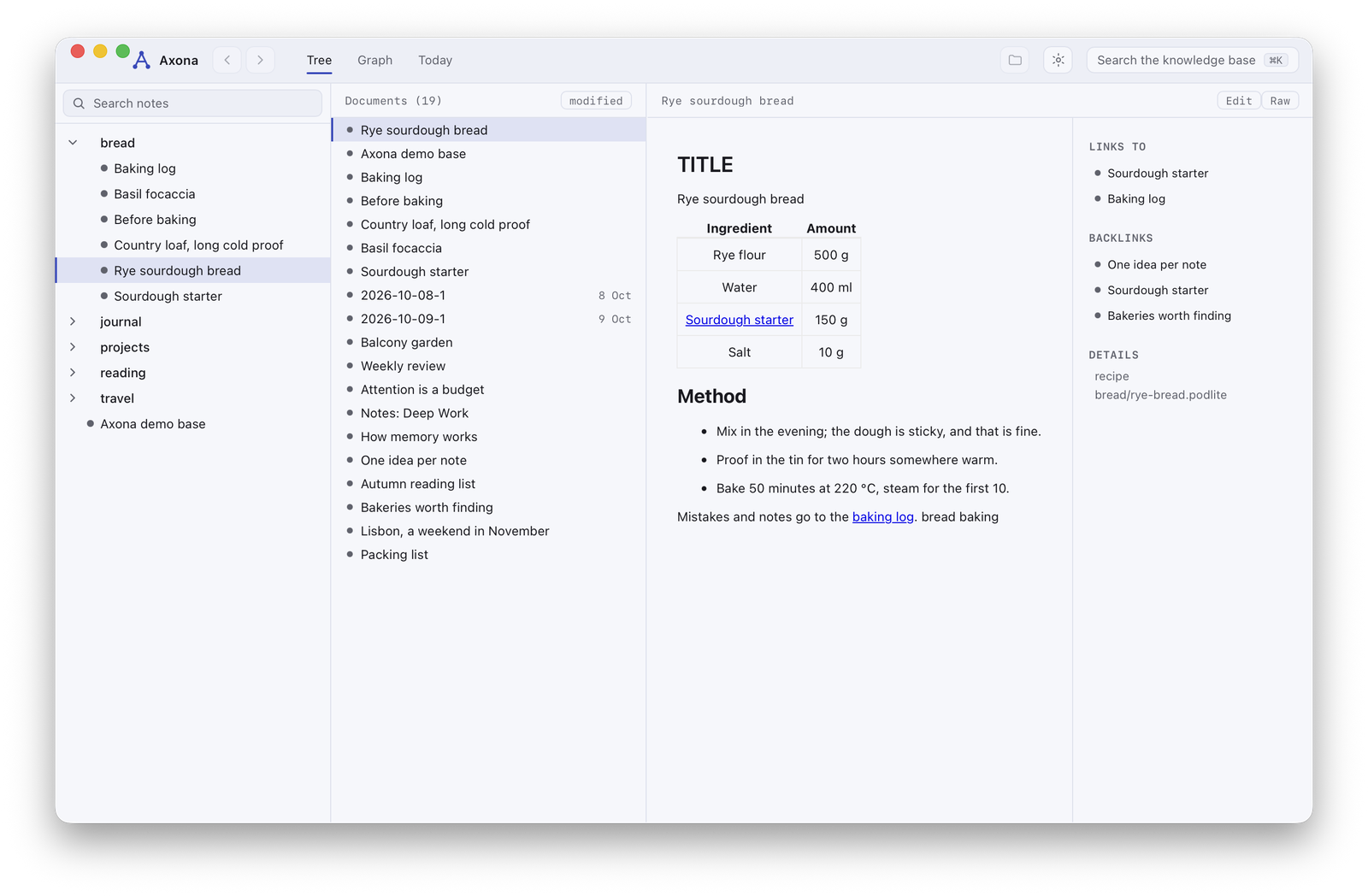
What I'm working on next:
an AI agent inside Axona, possibly more than one, and the tools that control how the agents run (the harness). The app must remain fully usable without an agent, just as it works without the internet today;
an MCP server, so external agents can work with the notes;
checks on document structure. Unlike Markdown, Podlite explicitly marks each block, so a checker can compare a file with an allowed structure and identify structural errors in documents written by an LLM.
Axona 0.1.1 for macOS (Apple Silicon and Intel) is available as a free download on the release page. There are no Windows or Linux versions yet. If you need one, or something doesn't work, open an issue.
Thanks.
© All rights reserved. 2022-2025. CC BY-SA 4.0. Made with podlite